Most business owners hear "automation" and picture the same thing: software that repeats a task over and over. That picture is five years out of date.
In 2026, automation splits into two distinct categories. Traditional automation follows a fixed playbook. AI agents read the situation and decide what to do next. The difference matters because picking the wrong one wastes time and money.
This guide breaks down the real differences, gives you a simple way to decide which approach fits your workflow, and shows what each looks like in practice.
What Traditional Automation Actually Does
Traditional automation is a recipe. You write down every step, and the system follows it exactly. If step three says "copy data from column A to column B," that is what happens every single time. No thinking. No exceptions.
Common examples in a business setting:
- Invoice processing: System reads a PDF, extracts the total, posts it to the accounting software. Same fields, same format, every time.
- Data entry: Moving information from a web form into a CRM. Fixed mapping, predictable output.
- Email notifications: Customer places an order, system sends confirmation email. Template-based, triggered by a single event.
- Report generation: Pull numbers from three databases, populate a spreadsheet, email it to the manager every Monday at 9 AM.
These tools use platforms like Zapier, Make, n8n, or custom scripts. They are reliable, cheap to run, and easy to audit. If something breaks, you check the logs and fix the rule.
The limitation is obvious: traditional automation cannot handle anything the recipe did not anticipate.
What AI Agents Do Differently
An AI agent is a system that reasons. It receives an objective — "qualify this lead" or "respond to this customer complaint" — and decides its own path to reach that goal.
AI agents use large language models to:
- Understand context: Read a long email thread and identify the customer's real problem, not just the surface complaint.
- Make judgment calls: Decide whether a support ticket is urgent enough to escalate, based on the language and history.
- Adapt to new situations: Handle a refund request formatted differently from the training examples without breaking.
- Chain multiple actions: Search the knowledge base, draft a reply, schedule a follow-up, and log everything in the CRM — all in one go.
The key word is autonomy. An AI agent does not need you to program every branch of every decision tree. It figures out the branch.
A Real Example: Customer Support Triage
Let us walk through the same task with both approaches. A mid-sized software company receives 200 support emails per day. The team of four agents is overwhelmed.
Traditional automation approach:
- Write rules based on keywords. If the email contains "password," send the password reset article. If it contains "billing," forward to the billing team.
- Works for about 60% of emails. The other 40% get routed wrong or bounced back because no rule matches. The support team still handles 80 emails a day manually.
AI agent approach:
- The agent reads the full email thread. It understands that a message mentioning "password" and "I am traveling" and "I did not authorize this" is actually a security concern, not a simple reset request.
- It categorizes the ticket, drafts a response with the proper tone, pulls relevant order details, and flags it for human review because the word "unauthorized" triggered a risk assessment.
- The support team now handles 30 emails a day — the genuinely complex ones. Everything else is triaged, drafted, or resolved by the agent.
The difference is not technology. It is judgment. The AI agent exercised judgment that would have taken hours of rule-writing to approximate.
When to Use Traditional Automation
Traditional automation is the right choice when:
- The process is predictable. Every invoice has the same fields. Every order confirmation uses the same template.
- The cost of mistakes is low. If the wrong customer gets a newsletter, nobody panics.
- You need speed and reliability. Rule-based systems process thousands of records per second without hallucination.
- Compliance requires traceability. Every action is deterministic. You can point to the exact rule that made every decision.
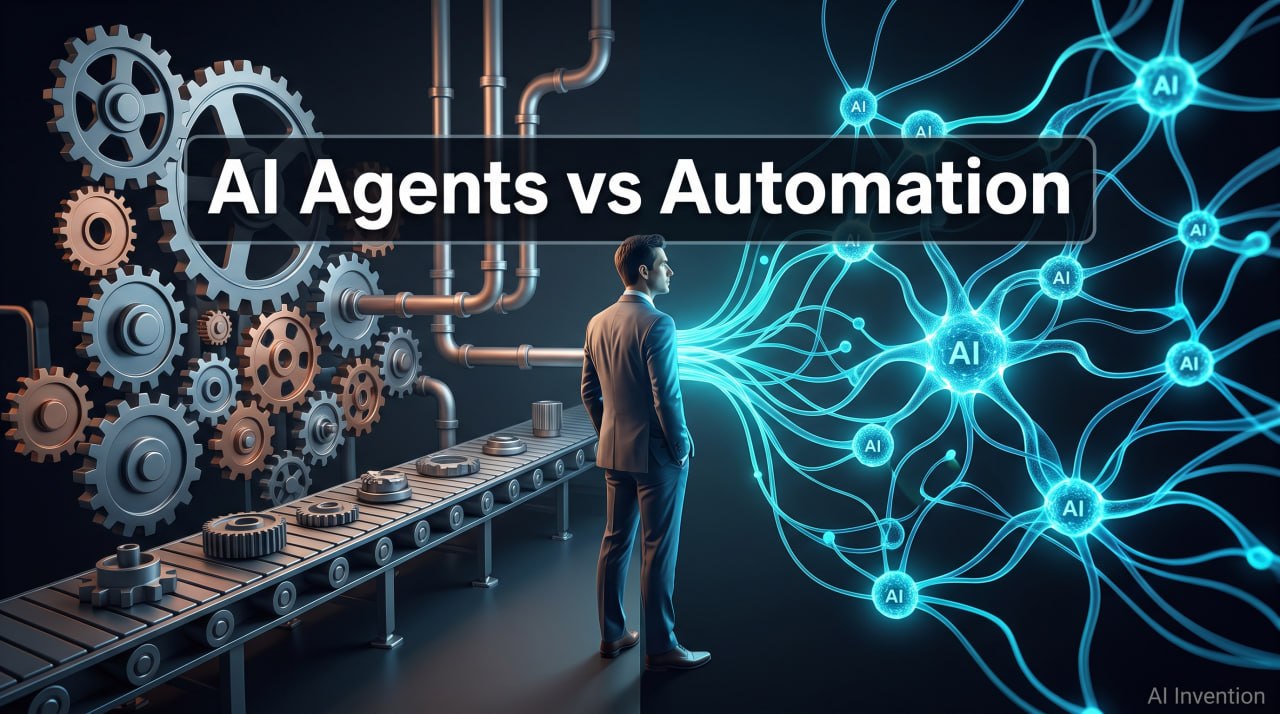
Think of traditional automation as a factory assembly line. Fast, consistent, limited in what it can produce.
When AI Agents Are Worth the Complexity
AI agents earn their cost when:
- The task requires judgment. Is this customer angry or just confused? Should this invoice get flagged for review?
- Inputs vary widely. Customer emails come in different formats, lengths, and tones. No fixed rule handles all of them.
- Context matters across steps. A sales lead who asked about pricing and then went silent for two weeks needs a different follow-up than one who just visited the pricing page yesterday.
- The process changes often. Agent behavior can be modified by updating instructions, not rewriting code.
The trade-off is cost and control. AI agents are more expensive per transaction because they use language model APIs. And they will occasionally do something surprising — which is both their strength and their risk.
Three Questions to Pick the Right Approach
| Question | If Yes → | If No → |
|---|---|---|
| Can I write down every possible scenario? | Traditional automation | AI agent |
| Would a mistake cost more than $100? | Traditional (or human-in-the-loop agent) | AI agent |
| Does the task change week to week? | AI agent | Traditional automation |
Most businesses end up using both. Traditional automation handles the routine 80%. AI agents handle the messy 20% that used to sit in someone's inbox for three days.
Getting Started This Week
If you have not used either approach yet, start here:
- Pick one task your team does at least 10 times a week.
- Time how long it takes and write down every decision point.
- If the decisions are binary (yes/no, category A/B/C), automate it with a traditional tool.
- If the decisions involve reading, interpreting, or prioritizing, experiment with an AI agent.
The gap between these two approaches is where most of the productivity gains in 2026 are hiding.
Related Reading
For the full framework this guide builds on, see our complete 2026 guide to AI agents for business. Our companion piece on AI vs traditional automation: which does your business need walks through the same decision with a department-by-department breakdown, and what are AI agents: a simple guide is a good starting point if you are new to the topic.
AI Invention builds both traditional automation and AI agent systems for businesses that want to stop wasting time on repetitive work. See our AI automation services or explore AI agent development.